
By Alistair Brown, CEO of LumenStream.
Last updated: 6 October 2026
We once surveyed 60 depots for a UK manufacturer, and not one of them was worth upgrading on its own.
Each one was a small counter with a warehouse at the back. Priced one at a time, none of them saved enough to close a business case. Their CFO would never have looked at them site by site.
Together, the same 60 sites became one project that paid for itself.
How? Well, the way to upgrade lighting across dozens of small sites is to stop pricing them one at a time.
Survey each site and turn its savings into the revenue that pays for its upgrade. Then stack every site's costs and savings into one model, so the busy sites carry the quiet ones, and present the whole estate as one project.
In finance, this is called aggregation.
So, if you run depots, trade counters, shops, leisure sites or a public estate, and your smaller sites keep failing the business case, this guide is for you.
Let’s go through the method, step by step, with those 60 depots as the example.
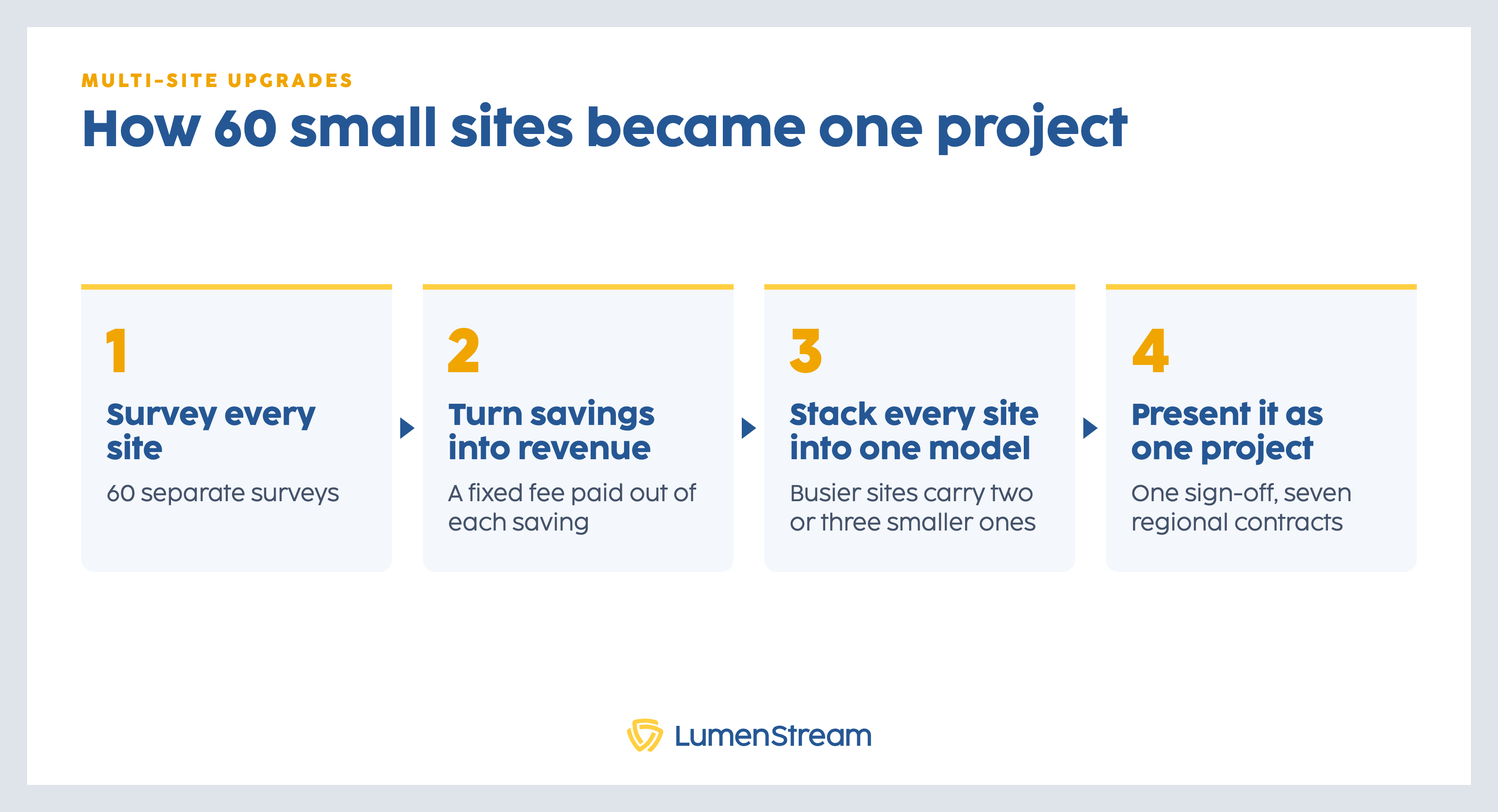
Step 1: Survey every site on its own
Every site gets its own survey, because a warehouse running 24 hours a day and a small office open 9-5 use their lighting in completely different ways.
For the manufacturer, that meant 60 separate surveys before anyone added anything up.
- You send us the full list of sites, with drawings where you have them. If a site has no lighting drawings, our engineer measures mounting heights and fitting positions on the visit.
- An engineer visits each site and counts every fitting, working or not, including older LED fittings that may already be due for replacement (We Already Have LEDs).
- You check each site's operating hours and give us the electricity price you actually pay, so the savings are built on your numbers rather than a national average.
- Each site gets its own lighting design, checked for light levels, evenness and glare, the same way we design any single site (What Facilities Managers Need to Know About Lighting).
Why go to that much trouble for lighting? In the government's Building Energy Efficiency Survey of UK non-domestic buildings, internal lighting was the most common end use of electrical energy: 21,260 GWh of the 84,820 GWh used each year (BEES, published 2016).
Pro tip #1: Include the sites you have already written off
The smallest sites are the reason to do this at all, so they go on the list first.
Surveyed one by one, every one of the 60 depots failed on its own, and every one stayed on the list. We don't charge for surveys or proposals, so adding a site you had given up on costs you nothing.
Pro tip #2: Get each site surveyed in person instead of remotely
A number you can't trust at one site becomes 60 numbers you can't trust across an estate.
Desktop estimates go wrong in ways a site visit catches. In one case we describe in Is Lighting as a Service Too Good to Be True?, a desktop estimate put the savings at £22,000 a year. Once our technical lead had seen the fittings, which were running at half the wattage we had been told, the figure came to £11,000.
With a cost and a saving for all 60 sites, the next question was what would pay for them.
Step 2: Turn each site's savings into the revenue that pays for it
Each site pays for its upgrade through a fixed monthly fee that comes out of its saving on the electricity bill, so no capital is spent.
- We work out each site's yearly saving from the lighting you have now against the lighting replacing it, the hours it runs, your electricity price and, where it applies, what you spend on maintenance today.
- We price the upgrade at each site.
- The cost becomes a fixed monthly fee over 60 months, at 0% interest and with no link to inflation (What Is Lighting as a Service?).
- You see both routes side by side for every site: buying the lights outright, and paying for them as a service (The Ultimate Guide to LED Lighting Upgrades in the UK).
Pro tip #3: Know why a single small site cannot get financed
This is the step where each of the 60 depots, on its own, fell over.
A UK government call for evidence in 2018 put the problem this way: "Evidence suggests that projects need to be a minimum of £1m to attract third party finance, due to the high transaction costs involved" (BEIS, 2018). We can finance far smaller projects than that, but below about £10,000, a single project is usually hard to finance on its own.
A small depot's savings rarely close a standalone business case either. The payback stretches, and the CFO moves on.
Pro tip #4: Let the monthly payments carry the finance
Grouping the sites also changes how the project is funded.
Once the contract is signed, we group the fixed monthly payments from every site and pass them to our finance partners. That gives us the money to buy and install the equipment, so the number of sites is not what limits a project. The limit is having enough electricians to do the work.
Step 3: Stack every site's costs and savings into one model
This is where the 60 depots stopped being 60 failed cases and became one working one.
Add every site's upgrade cost into one total and every site's saving into another, then judge the estate as one project.
- We add up the upgrade costs across every site.
- We add up the savings across every site.
- You check the combined payback against the rule your board already uses to sign off projects.
- If you want to compare, we can model it both ways: all sites together, and site by site.
Pro tip #5: Let the busy sites pay for the quiet ones
In one model, the savings from the busiest sites carry the upgrades at the quieter ones.
None of the manufacturer's 60 sites cleared the bar alone. Once we added them up together, though, each of the busier sites generated enough savings to carry two or three smaller ones alongside it. Map your own sites by energy use, highest to lowest, and you can see which ones will do the carrying.
Pro tip #6: Judge the estate against your payback rule as a whole
A payback of around three years is the rule of thumb most CFOs will sign off.
A small site priced alone can stretch well past it and never reach the board. Measured as one estate, with the busy sites' savings counted in, the same sites face the same rule on better numbers. That is the difference between 60 separate cases and the one that went ahead.
| Priced site by site | Priced as one project | |
|---|---|---|
| Business cases | 60, one per site | 1, for the whole estate |
| Result | None cleared the bar | Went ahead |
| The smaller sites | Too small to finance alone | Carried by the busier sites, two or three each |
| Contracts | None | Seven, one per region |
Which leaves the part that decides whether the estate actually moves: how it's presented.
Step 4: Present it as one project
Put the whole estate in front of your board as one proposal with one sign-off, instead of one per site.
- You get one proposal and one sign-off for the whole estate.
- You sign directly with LumenStream, as one contract or one per region or site (more on that choice below).
- We roll the sites out on one programme. Work usually starts about four weeks after signing, a little longer in autumn, and our install team averages around 500 fittings a week.
- Each site is handed over, then covered by our on-site maintenance for the full 60 months.
Pro tip #7: Get each site's local leadership on board first
In a network like the manufacturer's, each site's local leadership has to back the idea before the estate can move as a whole.
Where sites run like separate businesses, start those conversations while the surveys are still running.
Pro tip #8: Roll it out the way your business already runs
One project doesn't have to mean one rollout.
The manufacturer wanted it split into seven regions, so we set it up that way, with a contract for each region. Installation across all 60 depots finished in November 2025. Every one now runs on LED. Each monthly fee is paid out of the saving it replaced.
3 questions multi-site buyers ask us before they sign
Q1: One contract, or one per site?
Either works, and so does something in between.
Each site can be a separate contract, and a lot of multi-site companies we work with now prefer one larger contract that covers every site. The 60 depots sat in between: seven contracts, one per region, inside one project. We can model whichever structure suits your estate.
Q2: Can we pilot one site first?
Yes.
You can start with a pilot on one or two sites and bring in the rest of the estate once you have seen the result. Because surveys are free, piloting first does not stop you pricing the whole estate at the same time.
Q3: Which sites should we leave out?
None, by default.
Rank the sites by hours of use so you know which ones carry the model, but keep them all in. Had the busiest depots been taken out of the manufacturer's 60 for a quick win, the smaller sites would have lost the savings that were carrying them.