A UK guide to upgrading your lighting with no upfront cost.
By Alistair Brown, CEO of LumenStream
Last updated: 31 July 2026
Lighting as a service lets a UK business upgrade to new LED lighting without paying for it up front. You pay a fixed monthly fee, funded by the energy you save, and at the end of the term the lighting is yours. Across our projects, the average energy reduction is 63.5% (as at July 2026).
If that sounds familiar, it should. You already run your software this way. You don't buy a perpetual licence for your accounting system, you subscribe, and support and updates come included. Lighting as a service applies the same idea to a physical asset. You subscribe to the outcome, a bright and efficient building, instead of buying and owning the hardware yourself.
For a lot of UK businesses, that one change is the difference between upgrading now and putting it off for another five.
What is lighting as a service?
Lighting as a service (LaaS) is a way to upgrade and maintain your premises to LED lighting for zero capital expenditure. Instead of a large one-off purchase, you pay a fixed monthly fee that is covered by the reduction in your energy bill. We survey your site, fund and install the upgrade, and maintain it for the length of the agreement.
Most lighting upgrades stall on capital. The LED technology has been ready for years. The money to buy it is what businesses struggle to free up, because even a cash-rich company has an annual capital budget, and a lighting upgrade has to compete in that budget against machinery, vehicles and the roof. It usually loses. Lighting as a service moves the decision out of the capital budget and into operating costs, where it pays for itself from the first month.
How does lighting as a service work?
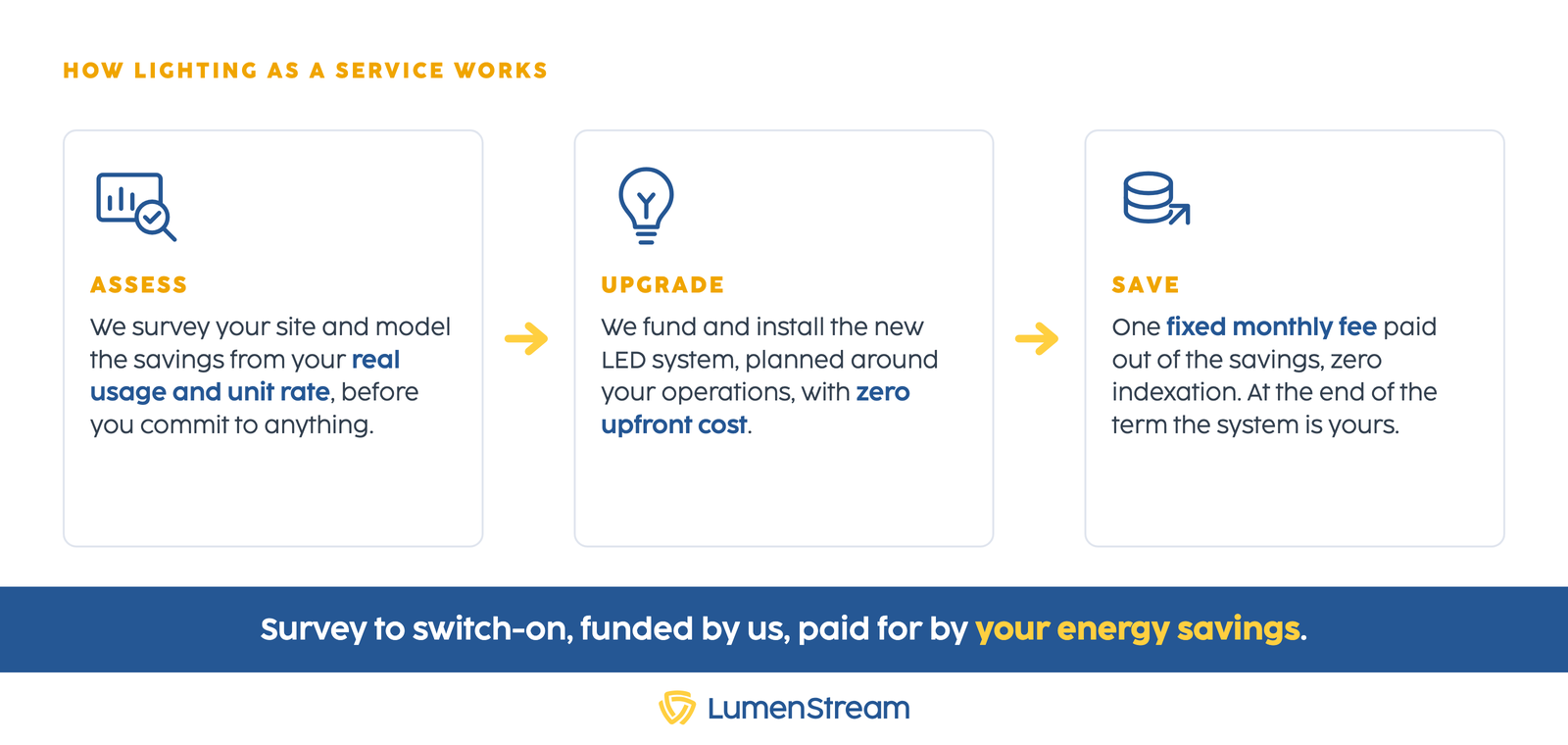
Assess. Our engineers survey your existing lighting and model the savings before you commit to anything. The projection comes from four inputs: the wattage of your current fittings against the new ones, how many hours a day the lights are on, your actual electricity unit rate, and what you currently spend maintaining old fittings. The projection is only ever as good as that data, which is why we verify it on site rather than working from a desktop estimate.
Upgrade. We fund and install the new LED system, and we plan the work around your operations so the site keeps running. Your old fittings are recycled through a WEEE-compliant scheme, and you receive a certificate of compliance.
Save. From the first month you pay one fixed fee that is smaller than the energy the upgrade saves you, so your cash position improves straight away. Across our projects, the average energy reduction is 63.5%.
How much does it cost, and is the monthly fee fixed?
The fee is a fixed monthly amount, set for the whole term, with zero indexation. That last part matters more than anything else on this page.
Many “no upfront cost” offers quietly raise the fee every year in line with inflation. Three percent a year stacks up to a 15.9% rise over five years, and RPI is unpredictable: it peaked at 14.2% in October 2022. The escalator usually sits in a clause the buyer never reads. We fix the fee for the entire term. If energy prices climb, your savings grow while your fee stays exactly where it started. You carry none of the inflation risk, and you always know your number.
Does lighting as a service sit on my balance sheet?
It depends who is asking. Private businesses land in different places, because every finance director has been trained somewhere different and reads the agreement their own way, and the rules changed in January 2026. Public sector buyers are more straightforward, since the treatment there is applied consistently rather than organisation by organisation.
Either way it comes down to how the agreement is written, so we would rather talk it through with your finance team than sell you “off balance sheet” as a feature.
Is it cheaper to just buy the lights outright?
Over the full term, no, and the gap is smaller than most people expect. If you buy outright you get the same equipment and the same energy savings. What you give up is the cash.
Here is how the three routes compare:
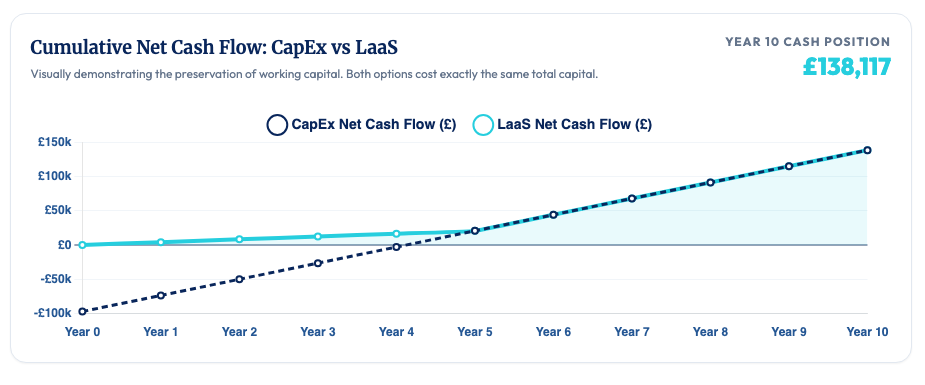
And here is what it looks like in pounds. This is the comparison that sits in every proposal we send. Buy, lease and service set side by side, with the compliance deadlines, is in The Ultimate Guide to LED Lighting Upgrades in the UK:
A project from our modeller, anonymised: a 494-fitting manufacturing site, a £97,040 upgrade saving £23,516 a year at the site's contracted unit rate, over a five-year term with 0% energy inflation assumed.
Same destination, very different journey. With CapEx you are £97,040 down on day one and it takes 4.1 years to climb back to zero. With lighting as a service you are in credit from the first month, you reach the same position by year five, and you own the system outright from then on. Your figures come from the survey, but the shape of it holds on almost every site: for around three in four of our clients, keeping the capital in the business is reason enough on its own.
For context on rates: the official average non-domestic electricity price was 24.14p per kWh in the first quarter of 2026 (DESNZ, Quarterly Energy Prices). This example runs at the site's own contracted rate, which is lower. Your survey uses yours.
Who is it best for, and who isn't it for?
Lighting as a service works best where the lights run long hours across a large or ageing site. In practice, that is:
- Manufacturing: factories and production floors on double or triple shifts, especially first-generation LED or old fluorescent high-bays.
- Logistics and warehousing: distribution centres and hubs where high-bays light aisles around the clock.
- Wholesale and large retail: showrooms, trade counters and multi-site estates with big back-of-house and loading areas.
- Commercial offices: larger and open-plan floors lit through long or hybrid working days.
- Healthcare and labs: clinics, labs and 24/7 facilities that need consistent, compliant light with no downtime.
- Sports and leisure: sports halls, pools and leisure centres with courts and studios lit for long hours.
The common thread is roughly twelve operating hours a day or more. That is what makes the savings large enough to fund the upgrade comfortably.
It is a weaker fit if your lights are only on for a few hours a day, even across a big building. There the savings are thinner, and we will tell you that plainly rather than dress up the numbers.
What happens at the end of the contract?
At the end of the agreement, which is typically five years, you have three options. You can let it expire and keep the system, at which point every pound of saving is yours. You can move to a rolling maintenance agreement so the lighting stays covered. Or you can upgrade again to the latest technology on a new agreement. There is no residual payment to own the kit, and no penalty for letting the term simply run its course.
Does it actually deliver?
Yes, and the numbers are public and checkable. Three of ours:
- Cooper & Turner, Glasgow: one of the UK's largest fastener manufacturers. 453 fittings replaced, lighting energy down 58%, saving 80 MWh and 54 tonnes of CO2 a year, with zero capital outlay. William McDaid: “There was no capital expenditure, so it was a no-brainer.” Read the story
- Siemens: 2,426 fittings upgraded, 68% more efficient, saving 305 MWh and 205 tonnes of CO2 a year. Read the story
- Alexander Dennis: 465 fittings across the site, 90 MWh a year saved, funded entirely from the savings. Read the story
Across all our projects the average energy reduction is 63.5%. We keep our case studies public and our figures specific on purpose. Inflated numbers are what make buyers distrust this whole model, so specific and checkable is the point.
For more, see all our client stories.