By Alistair Brown, CEO of LumenStream
Last updated: 13 August 2026
On 9 July 2026, Guy's and St Thomas' NHS Foundation Trust appointed Meridiam, a global infrastructure investor, as its Strategic Energy Partner. The deal delivers energy upgrades on an Energy as a Service model, with no upfront capital from the Trust. It is the first signed, publicly approved structure of its kind in the UK public sector. And the framework is open to a long list of other public bodies.
This article explains what was signed, how the model works, why the public sector could not buy it before, and what it changes for the people who run public estates.
What did Guy's and St Thomas' actually sign?
The Trust signed a first-of-its-kind Strategic Energy Partnership. It is a single-supplier arrangement: Meridiam designs, finances and delivers energy upgrades across the estate. The Trust buys its energy at an agreed cost.
The first project is a new heating and energy system at St Thomas' Hospital, replacing ageing infrastructure. Dalkia UK Energy Services is delivering it.
The framework is designed to be technology-agnostic. It covers heat, cooling, power and charging infrastructure rather than any single technology.
Delphine Gilbert, Managing Director of Dalkia Energy Services, said:
"This partnership shows how major NHS estates can decarbonise critical infrastructure while protecting capital for patient care."
You may have seen a £2 billion figure attached to this deal. The signing announcement states no contract value and no term. The tender notice before it, published in February 2025, proposed an eight-year framework. It allowed supplementary agreements of 40 years or longer, with an estimated value of around £2 billion over that longer horizon. Those were proposed terms. The signed deal's figures have not been published.
What is energy as a service, and how is it different from an energy performance contract (EPC)?
Energy as a service means you buy an outcome, such as heat or light, at an agreed cost. The provider funds, installs, owns and maintains the equipment that delivers it.
Most companies already buy their software this way. You pay while the service works for you, and you never own a server.
An energy performance contract (EPC) is the model the public sector knows better. The NHS has bought upgrades through EPCs for years: the Carbon and Energy Fund framework alone lists 57 projects and £864 million of capital (as listed on its site, August 2026). In an EPC, the public body still funds the asset, usually through borrowing or grants. The contractor guarantees a level of savings.
The difference sits in who funds the equipment and who carries the risk:
| Energy performance contract | Energy as a service | |
|---|---|---|
| Who funds the equipment | The public body, through borrowing or grants | The provider and its financiers |
| What you pay for | The asset, with a guaranteed level of savings | The outcome, at an agreed cost |
| Who owns the equipment | The public body | The provider |
| Who carries performance risk | Shared, backed by the savings guarantee | The provider |
For the lighting version of this model, see What is Lighting as a Service?.
Why couldn't the public sector buy this model before?
Because until July 2026, there was no publicly approved contract structure for it that a buyer could point at.
A private company can weigh a new contract model one CFO at a time. A public body cannot. It needs a structure that has already passed legal, accounting and procurement review inside public-sector rules. Without one, every as-a-service deal that reached the public sector got reshaped into some kind of lease inside the old rules. Or it stalled.
We watched this happen in 2024, when a UK university asked us to build a lighting upgrade with zero capital spend.
They were genuinely excited, and then the pitching started. Every vendor offered a different version of what the deal should look like. Many of the offers were not a service model at all. Nobody could point at any version and say: this has been approved by the public sector, it is good to go. The project never went ahead.
That is the gap this partnership closes. A structure has now passed public-sector legal and accounting review, and it is signed.
Is energy as a service the new PFI?
No, and the differences are worth spelling out, because PFI is the first objection a public-sector finance director will raise.
Under the Private Finance Initiative, private companies financed and built whole assets, such as hospitals and schools. The public body then paid a fixed charge, often for 25 to 30 years. The government abolished PFI for new projects in 2018. The National Audit Office counted over 700 live deals in 2018, with charges running into the 2040s.
Three differences matter:
- Scope. Energy as a service covers energy infrastructure. The public body is not renting back its own hospital.
- What you pay for. You pay an agreed cost for a delivered outcome, such as heat or light, rather than a fixed charge for an entire facility.
- Where performance risk sits. In a service contract, the provider carries the risk if the system falls short, because the service is what is being paid for.
Financing costs do not disappear in a service model.
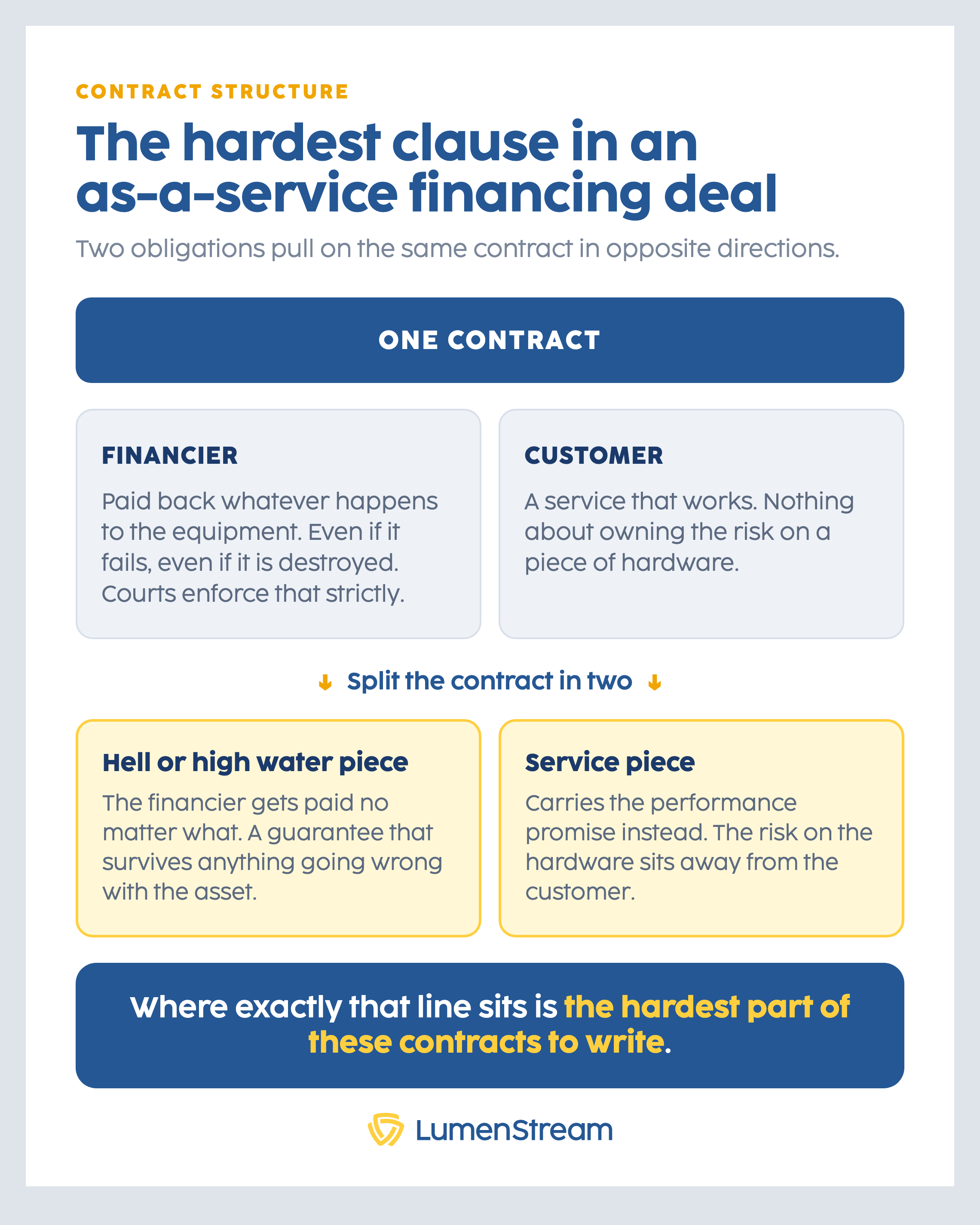
When financiers fund an asset, they want that asset paid for, whatever happens on site. The contract term for this is a "hell or high water" clause: in a pure finance lease, the payments continue even if the equipment fails. Courts enforce these clauses strictly. Service contracts handle it by splitting the agreement in two: an asset element and a service element.
Exactly where that line sits is the hardest part of these contracts to write. How the Guy's and St Thomas' structure draws it has not been published. What has been published is the outcome: it passed the Trust's legal and accounting review.
The other comparison worth making is with doing nothing.
NHS trusts were carrying £15.9 billion of backlog maintenance in 2024/25. Estates keep ageing while business cases wait for capital that rarely arrives. A model that funds the upgrade from the service it delivers is built for that specific problem.
Is energy as a service on or off the balance sheet for a public body?
There is no blanket answer. The accounting treatment of a service contract is decided case by case, by your finance team and your auditors.
We say that as a provider: we do not give accountancy advice. A provider who promises you a balance-sheet outcome is overreaching. Ask your auditor to test the contract against the standards you report under.
What the precedent changes is the starting point. Public bodies report under common frameworks. A structure that has passed one trust's legal and accounting review gives every other finance team a concrete reference. You are no longer the first to test it.
Who can use the Guy's and St Thomas' framework?
The published announcement names six groups the framework is open to:
- NHS trusts
- Integrated Care Boards
- Local authorities across south east London
- London boroughs
- Greater London Authority functional bodies
- The City of London Corporation
Those groups include bodies such as:
- King's College Hospital NHS Foundation Trust and Lewisham and Greenwich NHS Trust, two of south east London's acute trusts
- NHS South East London Integrated Care Board, which covers Bexley, Bromley, Greenwich, Lambeth, Lewisham and Southwark
- Transport for London and the London Fire Commissioner, which runs the London Fire Brigade estate. Both are Greater London Authority functional bodies, alongside the Mayor's Office for Policing and Crime and London's development corporations.
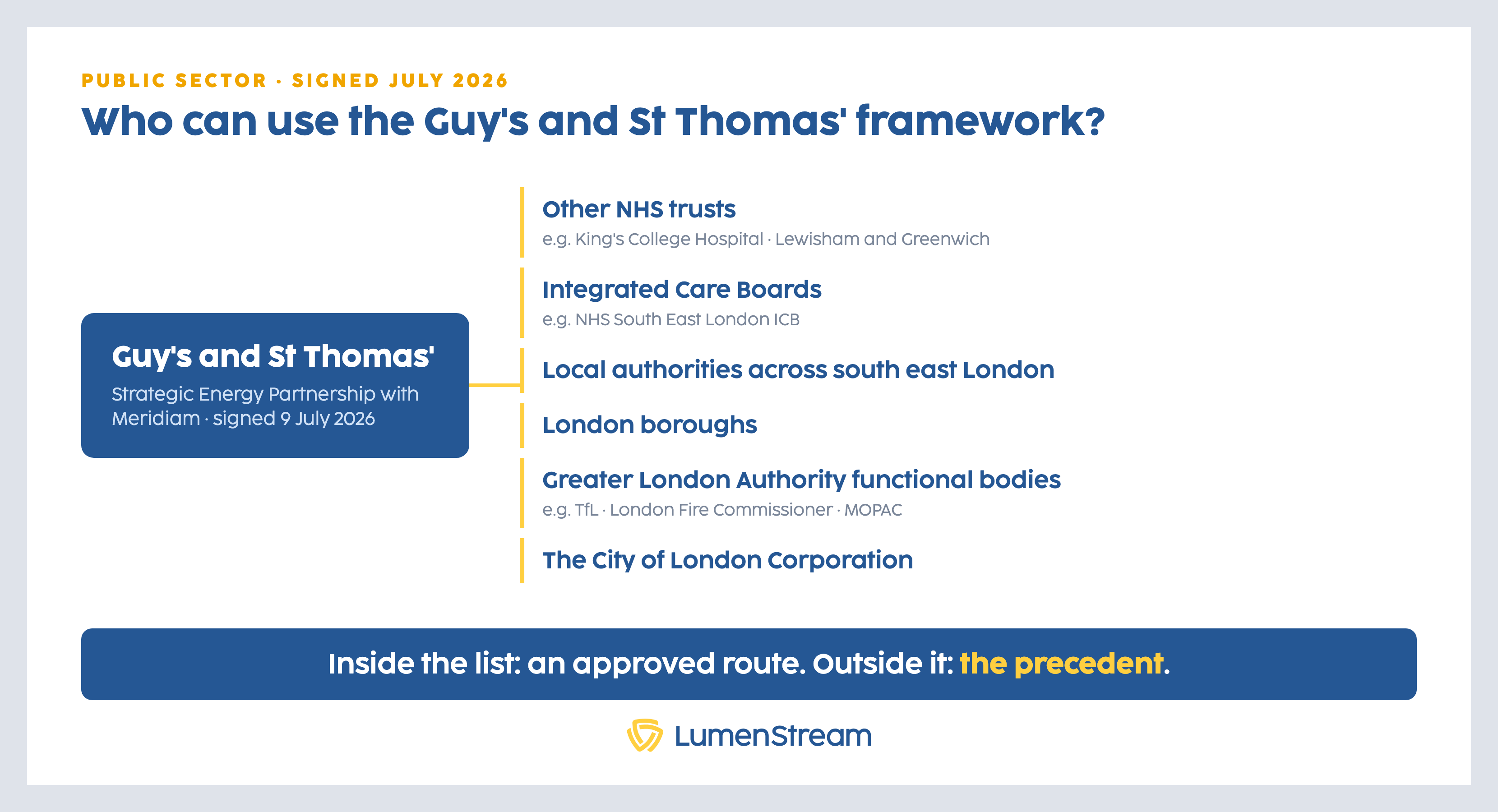
Whether and how any of these bodies use the framework is their own decision. What the announcement establishes is that an approved route now exists for them.
Universities are not on the list. What everyone outside the list gets is the precedent. The next estates team that proposes a zero-capital energy upgrade starts from a signed public-sector example instead of a blank sheet.
How do public estates fund energy upgrades now the grant window has closed?
The Public Sector Decarbonisation Scheme's last application window closed in November 2024. At the 2025 Spending Review, the government confirmed no further investment beyond projects already awarded.
The scheme allocated £1 billion in Phase 1 and over £1.4 billion in Phase 3 alone. Its funded projects continue delivering until March 2028. But as of August 2026 there is no open application route. And the NHS is still committed to net zero by 2040 for the emissions it controls directly.
That leaves three routes:
- Wait for a future grant round. None has been announced.
- Fund upgrades from capital budgets, where they compete with backlog maintenance and clinical priorities.
- Buy the upgrade as a service, funded by the savings it creates and paid for as an operating cost.
The Guy's and St Thomas' partnership is the first signed, estate-scale example of the third route in the UK public sector. That is why it matters well beyond one hospital.