By Alistair Brown, CEO of LumenStream
Last updated: 31 July 2026
Upgrading commercial lighting to LED is one of the quickest wins available to a UK business: done well, it cuts lighting energy by 65 to 85% (Carbon Trust), and at today's average non-domestic rate of 24.14p per kWh (DESNZ, Q1 2026), that adds up fast on a building of any size.
The upgrade itself comes down to three steps:
- A proper site survey
- A lighting design that hits the right lux levels without over-lighting
- And a funding route that suits your balance sheet.
This guide walks through all three: what an upgrade involves, what it costs, how much it saves, and how to pay for it without touching capital. It is written for the person who signs off the spend, not the person who fits the lights.
How much can an LED upgrade actually save on energy bills?
Between 65 and 85% of your lighting energy, if you are replacing halogen. The Carbon Trust puts the saving from swapping halogen for LED in that range (2014 research, still its most recent published figure), and around 20% where you are replacing compact fluorescent or high-intensity discharge fittings. Add controls (occupancy sensors and daylight dimming) and you save more again on top, because a well-zoned system stops lighting empty aisles at full output.
Be wary of any supplier quoting a flat "up to 90%" headline.
It is achievable only in narrow cases and it is the kind of round number that makes a finance director stop trusting the rest of the proposal. The honest range is 65 to 85% against halogen, plus whatever controls add for your specific building.
The reason it matters now is price.
UK non-domestic electricity averaged 24.14p per kWh in the first quarter of 2026 (DESNZ). Lighting is often a fifth of a commercial building's electricity, and it runs during exactly the hours the building is occupied and rates are highest.
How do I know if my building is due an upgrade?
Two questions answer this: how old is the installation, and what does it measure today.
If your fittings pre-date 2015, you are almost certainly running first-generation LED or, more often than owners expect, legacy fluorescent tubes. Those tubes are now being phased out. The mercury exemptions that kept most T5 and T8 fluorescent tubes on sale were revoked, with UK enforcement from 1 February 2024, so replacements are getting harder to source and more expensive to hold.
There is also a compliance clock for rented commercial property.
Under the Minimum Energy Efficiency Standard, privately rented non-domestic buildings already need an EPC of E, and the government's June 2026 interim response sets a target of EPC B by 2031 for buildings over 1,000 square metres. Lighting is one of the cheapest routes to move an EPC band.
The other test is measurement.
LED fittings fade before they fail, so a ten-year-old system can look fine and still have dropped well below the light level it was designed for. If you want the detail on that, we wrote about it here: We already have LEDs. What now?
What does a commercial LED upgrade cost, and is it worth it?
The honest answer is that cost depends on the number of fittings, their mounting height, and the design, so anyone quoting a single per-square-metre number without seeing your site is guessing. What a good supplier can tell you before you commit a penny is the saving, because that comes from your own bills and a certified survey.
For example, at Wickes, one of our UK customers, a 745-fitting upgrade cut lighting energy by 36% and saves 491 MWh and 330 tonnes of CO2 a year.
"Is it worth it" is really a cash-flow question, and it depends on how you pay.
That is the next section.
Ciarán Maxwell, Ryobi's Low Carbon and Renewable Energy Project Engineer, put it this way:
"It's been night and day! We already see a massive lighting improvement and everyone's been talking about the benefits that this brings to the factory. LumenStream have been very open and honest, very fast and efficient and great value for money."
Should I buy the lights outright, lease them, or use Lighting as a Service?
There are three ways to fund an upgrade. They end at the same lighting; they leave your business in very different cash positions.
| Buy outright (CapEx) | Lease / hire purchase | Lighting as a Service | |
|---|---|---|---|
| Upfront cost | Full project cost | Zero | Zero |
| Who funds it | You | A lender (with interest) | We do |
| Maintenance | You arrange it | You arrange it | Included for the full term |
| Indexation | n/a | Often RPI-linked | Fixed, zero indexation |
| End of term | You own it | You own it | Ownership transfers to you |
| Capital tied up | Yes | Partly | No |
The detail most buyers miss is indexation.
A monthly fee that rises with RPI looks small on paper. Over five years at 3% it becomes a 15.9% increase, and RPI is volatile: it peaked at 14.2% in October 2022.
A fixed fee removes that risk entirely.
In pounds, on an example from our modeller (anonymised): a 494-fitting manufacturing site is a £97,040 project saving £23,516 a year. Buy outright and the £97,040 leaves the business before the savings start; on the service route it stays in the business and the fixed fee comes out of the £23,516. The full year-by-year position is in What is Lighting as a Service?
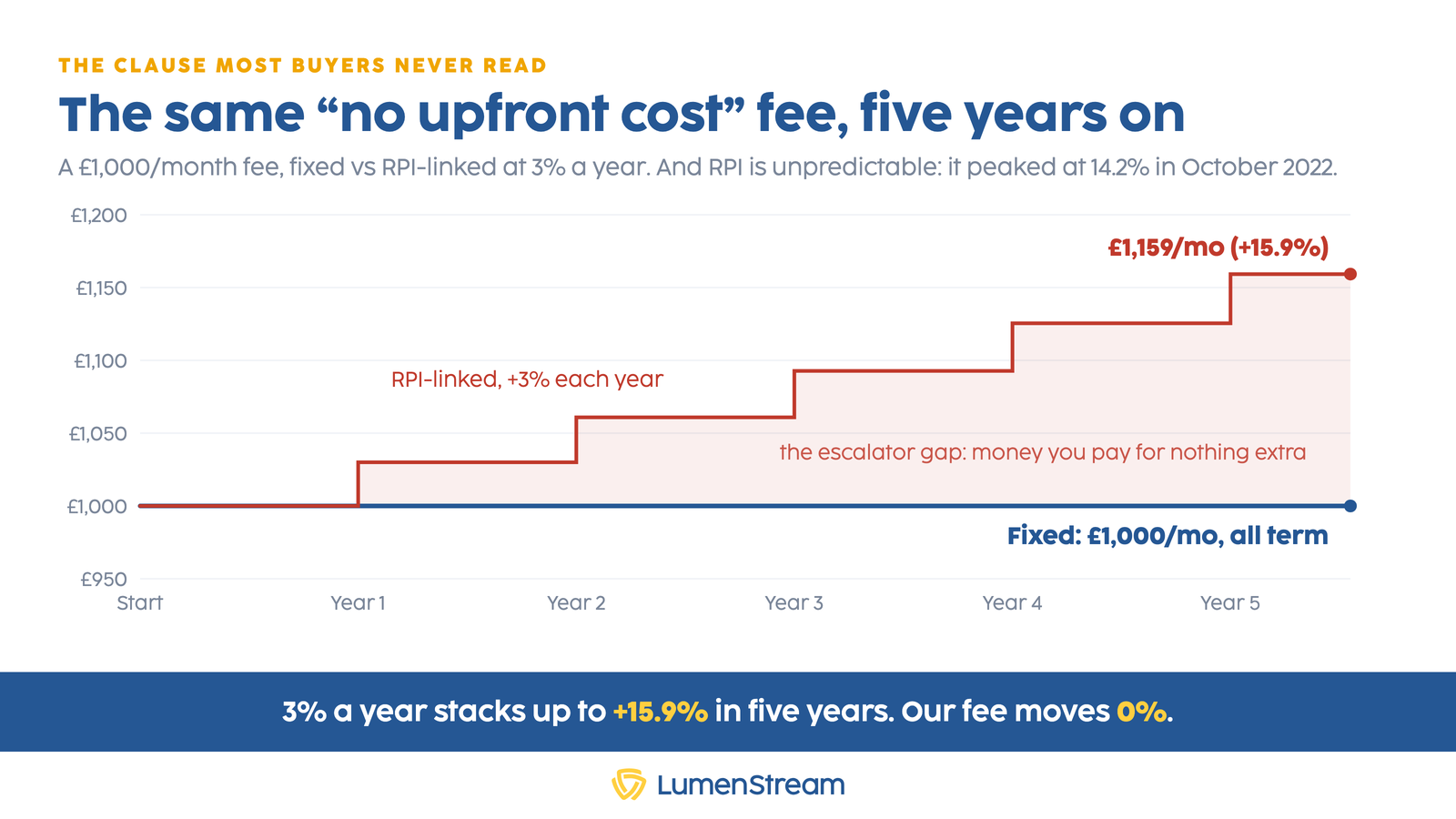
A £1,000/month fee fixed vs RPI-linked at 3% a year: the indexed fee reaches £1,159 (+15.9%) after five years of rises. RPI peaked at 14.2% in October 2022.
Lighting as a Service is the turnkey, end-to-end version of this: we survey, design, fund, install and maintain the system, and you pay one fixed monthly fee out of the savings. It is the same idea you already run your software on. You do not buy a server room to use email; you pay a predictable fee and someone else owns the risk.
Does an LED upgrade sit on my balance sheet?
It depends on how the agreement is written and on how your own finance team reads it, and the rules changed in January 2026. We would rather talk it through with them than give you a blanket answer. More on it in What is Lighting as a Service?
What should I check before choosing a provider?
Four things separate a good upgrade from an expensive one.
- A proper lighting design. Insist on a design (lux levels, uniformity, glare limits to UGR standards) using software like DIALux, not just a parts list. Over-lighting is wasted money; glare is a health-and-safety problem.
- Maintenance terms. A product warranty covers a faulty part. It rarely pays to remove, test and refit a failed unit at height, and it often assumes fewer operating hours than you actually run.
- The old fittings. Old lamps are covered by WEEE regulations. A good supplier handles compliant recycling (we work with Recolight); a cheap one leaves it with you.
- The questions to ask any provider, including us. Is the fee indexed? Who carries the risk if a fitting fails? Is the quote based on a real survey or brochure lumens? Will you show me a named reference site?
Does this apply to my building?
Lighting as a Service suits buildings with long operating hours and a reasonable number of fittings: warehouses, factories, distribution centres, leisure and healthcare estates, retail, offices, and public-sector buildings. It is a poor fit for very small premises, short-lease sites, or mood-lit hospitality where the lighting is part of the brand. If it is not right for you, we will tell you.
If it is a fit, the quickest way to see the numbers on your own building is a survey.