By Alistair Brown, CEO of LumenStream
Last updated: 31 July 2026
Because LED fittings fade before they fail. A first-generation system installed ten years ago can still switch on and still look fine, while quietly running at 30% less light than it was designed to deliver. The good news is you can fund a second upgrade the same way you should have funded the first: from the savings, without touching large capital.
If you upgraded to LED years ago and thought lighting was handled, this is the article for you.
Why would we upgrade LEDs that still work?
Because "still works" and "still efficient" are different things.
LEDs do not blow like a bulb; they lose output slowly. The industry measures this as L70, the point where a fitting has dropped to 70% of its original brightness and is considered spent. People rarely notice a gradual 30% loss, so the room dims below its designed level and nobody flags it.
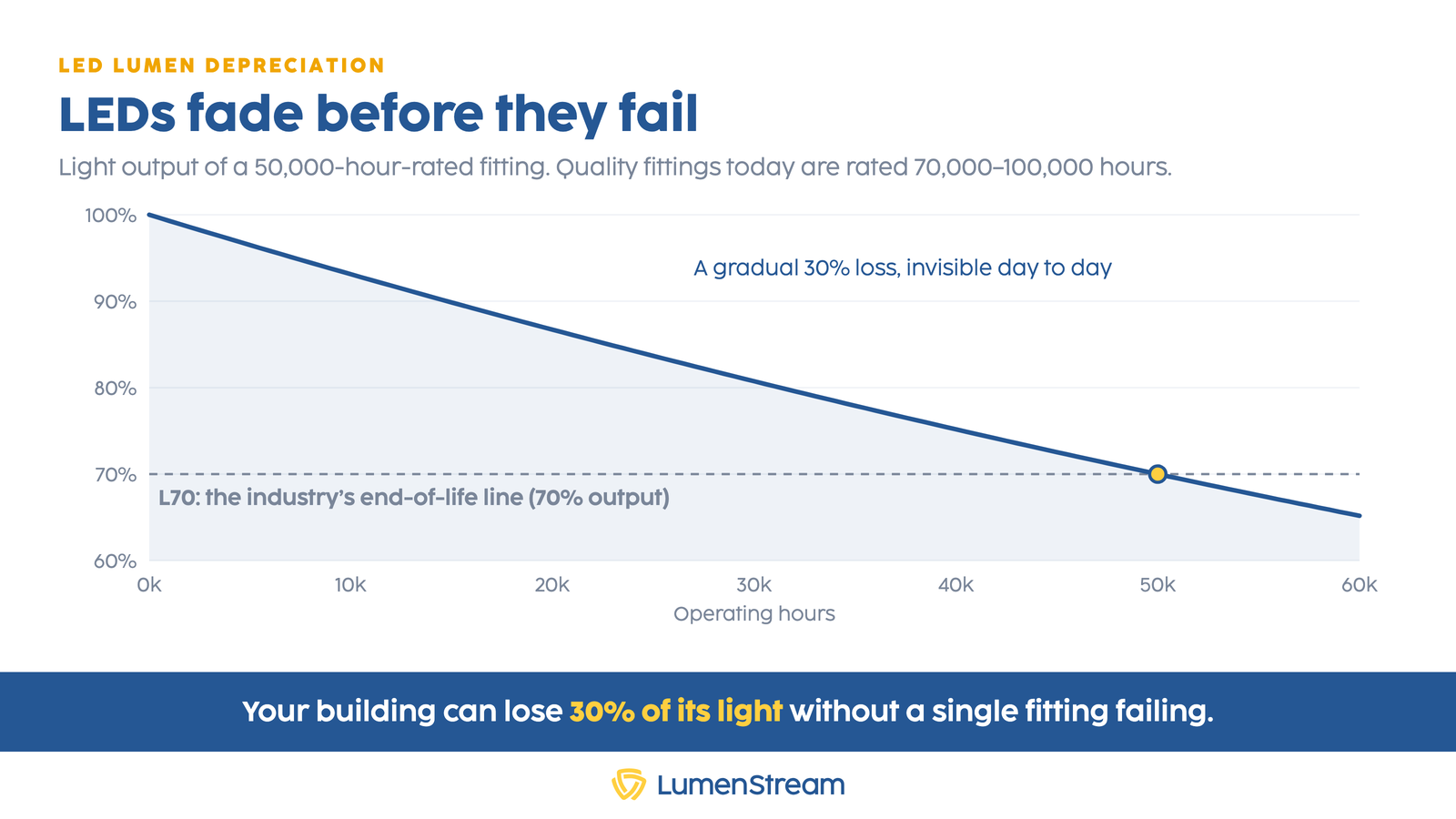
Light output of a 50,000-hour-rated LED fitting: a gradual fade to L70, the industry's 70%-output end-of-life line.
Age matters too.
Early commercial LED fittings were rated to a minimum of around 50,000 hours. Quality fittings today reach 70,000 to 100,000 hours, so a first-generation install is often both dimmer and shorter-lived than what would replace it.
And a fair number of buildings that believe they are "on LED" are still running legacy fluorescent tubes in parts of the estate.
Those tubes are being phased out: the mercury exemptions were revoked, with UK enforcement from 1 February 2024, so they are getting scarcer and dearer to replace like-for-like.
How do I know when it's actually time?
You can measure it in minutes. Three signs point to a system past its best:
- Visible flicker or dead fittings. This usually points to a failing driver rather than the LED itself.
- A room that feels darker than it used to. Trust the measurement, not the memory: a handheld lux meter tells you whether you are below the level the space was designed for.
- Rising maintenance calls as drivers reach end of life across the installation.
If the lux reading is well under target, the system is costing you money and light at the same time.
And if the readings still meet the design level, keep your money. A re-upgrade pays back fastest on long operating hours and visible fade; short hours and a healthy lux reading mean the honest answer is to wait.
A rule of thumb by installation age:
| Installed when | What you're likely running | What to check |
|---|---|---|
| Before ~2012 | Legacy fluorescent or HID, possibly part-retrofitted | Tube availability (the RoHS ban), energy use, lux levels |
| ~2012–2018 | First-generation LED, 50,000-hour-class fittings | Output against the design level (L70), driver failures |
| ~2018–2022 | Mid-generation LED, controls vary | Lux readings, zoning and sensors, maintenance call rate |
| Last ~3 years | Current-generation LED | Nothing yet. Measure yearly and keep your money |
How much are we losing by leaving it as is?
More than your repair bills show.
A degraded fitting still draws close to its original wattage while delivering less usable light, so you pay old-technology energy rates for a room that no longer meets its design.
You can size this yourself.
UK non-domestic electricity averaged 24.14p per kWh in Q1 2026 (DESNZ), and grid electricity carries 0.131 kg of CO2e per kWh (DESNZ 2026 factors), so every MWh you save is worth roughly £240 and 0.13 tonnes of CO2e.
For scale, at Siemens a re-fit lifted efficiency by 68% and now saves 305 MWh and 205 tonnes of CO2 a year across 2,426 fittings. At the current average non-domestic rate, that is roughly £74,000 a year off the electricity bill.
That is the gap a tired system leaves on the table.
How do we fund a second upgrade without large upfront capital?
There are three routes, and only one of them needs no capital at all:
- Capital expenditure. You buy the system. It works, but it ties up cash in a depreciating asset and competes with every other project for budget.
- Hire purchase or credit. You spread the cost, with interest, and typically carry it on the balance sheet.
- Lighting as a Service. We survey, fund, install and maintain the upgrade. You pay one fixed monthly fee out of the savings, with zero upfront cost.
The honest problem with a second upgrade: nobody budgeted for it.
The dramatic savings from going legacy-to-LED landed years ago and were absorbed into the business, so there is no obvious budget for round two. A service model fixes that by funding each generation of lighting from the savings of the last, instead of asking finance for a fresh capital every decade.
After the re-fit, James Dybell, Siemens' Head of Environmental, Health and Safety, said:
"Finding the one-stop shop that helps source the right products, manages installation, safety, and the overall success of the project, whilst offering that unique service was fantastic. I would definitely recommend LumenStream!"
Will the monthly fee creep up with inflation?
No. The fee is fixed for the full term, with zero indexation. That's the part every Finance Director will love.
Many funded-lighting and lease agreements link the monthly charge to RPI. That looks harmless until you add it up: 3% a year becomes a 15.9% rise over five years, and RPI is unpredictable, having peaked at 14.2% in October 2022. A fixed fee removes that risk. If energy prices spike, your savings rise while the fee stays flat.
Does this sit on our balance sheet?
It depends on how the agreement is written and who is reading it, and the rules changed in January 2026. Treat any blanket "off balance sheet" claim with caution, ours included.
We would rather go through our agreement with your finance team than put a flat answer here. More on it in What is Lighting as a Service?
What happens at the end of the contract?
The system becomes yours, at no extra cost, and you keep 100% of the savings from then on. You can also roll into maintenance or upgrade to the next generation of technology. There is no balloon payment, hidden premiums, and no handing the kit back.
For the full detail on what secures a Lighting-as-a-Service contract, see What is Lighting as a Service?