A UK buyer's guide to what the agreement says, and what it doesn't.
By Alistair Brown, CEO of LumenStream.
Last updated: 22 September 2026
Short answer: no.
In fact, ‘too good to be true’ is THE most common objection we get. All thanks to our LED Lighting-as-a-Service model.
Lighting as a service means a UK business gets new LED lighting with no upfront cost, pays a fixed monthly fee for 60 months, and owns the lights at the end. For example, across our 113 buildings, the average energy reduction is 63.5% (as at July 2026). The fee comes out of that saving, which shows up on your very first bill.
I worked in law before I started LumenStream, and the habit I kept is to read the clause before I believe the pitch.
So, we wanted to compile the nine most common questions sceptical finance directors, procurement leads and facilities managers ask us, and what we normally say.
How does a lighting company make money if the upgrade is free?
The upgrade is not free. You pay for it over 60 months, out of the energy you stop wasting.
For example, we survey the site, design the scheme, fund the equipment, install it and maintain it for the term. The monthly fee is the cost of that project split over 60 months at 0% interest. Because the saving on your electricity bill is larger than the fee, you are better off from month one, and we are paid over five years instead of on day one.
That's the whole model, and it's just counting: does the saving clear the fee, every month, for 60 months? If yes, the maths works, and there's nothing else to it.
Where we make our money is the project itself, the same way a furniture retailer like Wren Kitchens or DFS Sofas makes money on interest-free finance. They buy directly from the manufacturer rather than through a wholesaler, which leaves enough margin to absorb the cost of financing. We do the same: we buy equipment at OEM level, and that margin is what makes the 0% number work.
Every proposal lists the technology cost and the installation cost per unit, so you can put it next to any third-party quote. We do that on purpose. It keeps us honest on our pricing, and it means the question “where's the margin?” has an answer you can check line by line.
One customer's finance team wanted a second opinion, so we pasted the full proposal, with their own numbers, into an AI model and asked it which route left them better off. It chose the service agreement.
You can run the same test on any proposal you're sent.
Is it cheaper to just buy the lights outright?
Over the full term, no, and the gap is smaller than most buyers expect.
If you buy outright, you get the same fittings and the same energy saving. What you give up is the cash, and the return that cash would've earned in your business. For example, on a £22,030 project we modelled both routes for the customer: the service route came out £2,954 better on a net-present-value basis. The full three-way comparison, buy, lease and service, sits in our guide to lighting as a service.
Laura Courtney, Head of Engineering Finance at Alexander Dennis, said:
“The project has significantly improved the lighting on site, not only in our workshop and paint booth areas, but in our offices as well. And best of all, there is no large deposit, only monthly payments over a five-year period.”
Will the monthly fee go up with inflation?
No. The fee is fixed for the full 60 months, with zero indexation.
Many funded-lighting and lease agreements link the monthly charge to RPI. Three percent a year becomes a 15.9% rise by year five, and RPI doesn't stay at three percent: the annual rate was 14.2% in October 2022 (ONS, 2022). A facilities lead at a precision engineering manufacturer had run a lighting-as-a-service agreement before, with annual increases built in. On a demo, he told us that no RPI adjustment was the key difference.
If energy prices rise, your saving grows and the fee stays where it started. We explain the escalator clause, and where it usually hides, in We already have LEDs. Why would we upgrade again?
Does the provider take a cut of my energy savings?
No. You pay a fixed fee out of the saving, and everything above it is yours.
The confusion is understandable, because a different contract type works exactly that way. In an energy performance contract, the provider is paid from the savings it delivers. The IEA describes the two most common forms as shared savings and guaranteed savings models.
A manager at a bus manufacturer told us on a demo that he had it in his head we took a percentage of the savings. It's an easy mix-up, because the fee does come out of the saving. The difference is that our fee is set before you sign: the installation cost split over the five-year period. If your saving beats the forecast, the fee stays the same and you keep all of the extra.
| Fixed-fee service agreement (ours) | Shared-savings energy performance contract | Lease or hire purchase | |
|---|---|---|---|
| What you pay | A fixed monthly fee for 60 months | A share of measured savings | Fixed instalments, often indexed |
| If savings beat the forecast | You keep all of the extra | The provider takes its share | You keep it |
| If savings fall short | You still owe the fee; if the system isn't working and we don't put it right, you stop paying | The provider's income falls | You still owe the instalments |
| Who maintains the lights | We do, on site, for the term | Depends on the contract | Usually you |
| Who owns the lights at the end | You do, at no cost | Depends on the contract | You do |
Which raises the next question: how do we know the forecast is right?
How do I know the savings will show up on the bill?
Because the calculation uses your numbers, and you see every line of it before you sign.
The saving is:
(Old fitting wattage - the new fitting wattage) x your operating hours x the unit rate on your own bill.
The wattages come from the certified data sheets. The hours and the rate come from you. For context, the average UK non-domestic electricity price was 24.14p per kWh in the first quarter of 2026 (DESNZ, June 2026). A survey that assumes a higher rate than you pay will overstate the saving.
We work from fitting wattage rather than a meter for a practical reason. In most buildings, lighting, heating and machinery run through one supply. As Steph on our team puts it, the bill is a smoothie, and you can't un-blend it to find the lighting.
The risk to watch is the baseline.
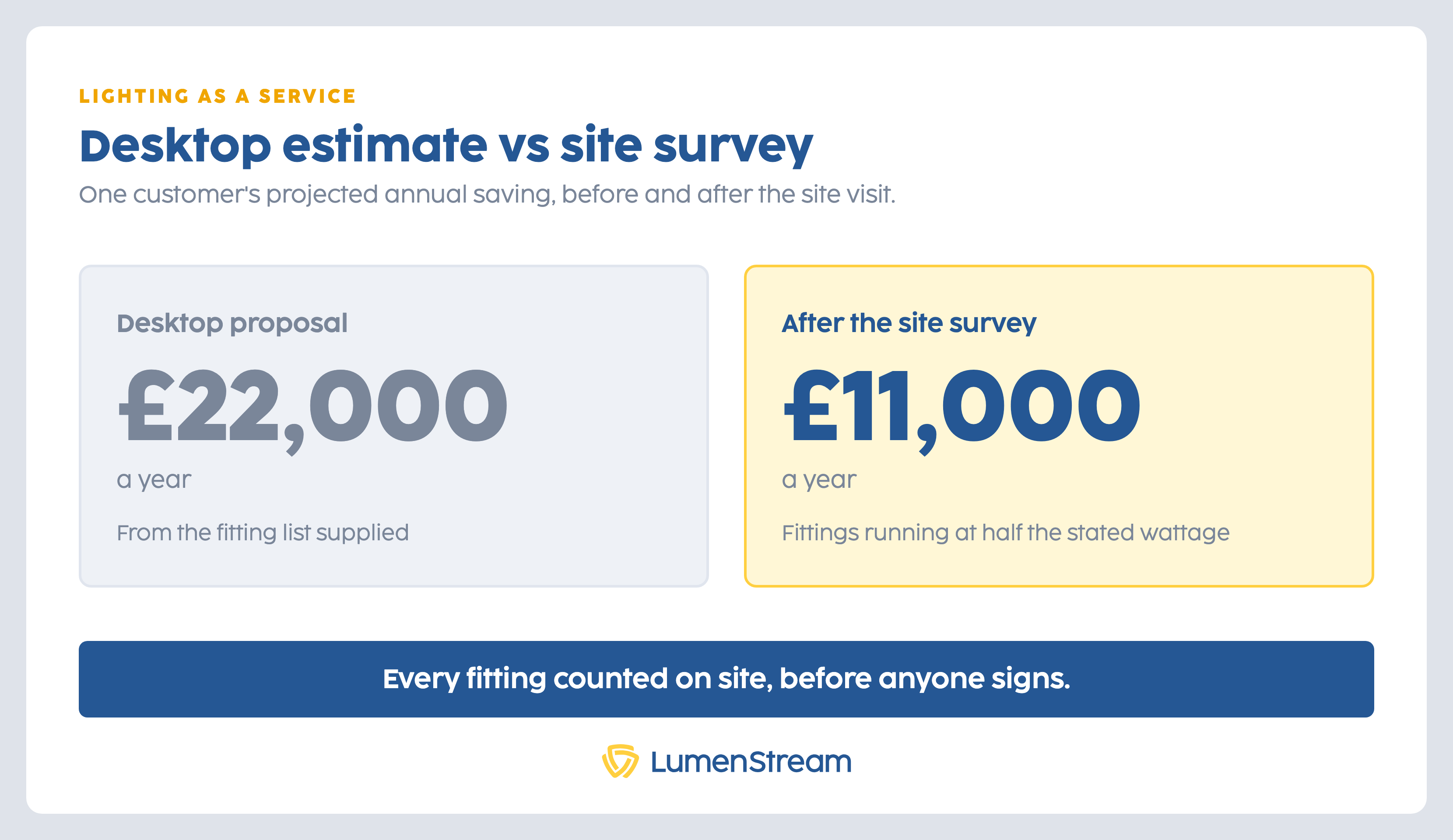
In December, a customer asked for a desktop proposal before committing to a site visit. Based on the fitting types and quantities they gave us, we projected £22,000 a year in savings. When our technical lead visited the site, the fittings were running at half the wattage we'd been told, and the figure came to £11,000. We went back and told them before anyone signed anything. A proper survey counts every fitting on site, working or not, which is why we send someone before you sign, not after. If you would rather use your own maintenance data, or strip maintenance out of the calculation entirely, you can.
Is maintenance really included, or is it just a warranty?
Included, on site, for the full 60 months.
A product warranty covers the part. If a fitting fails, you take it down, post it back, wait for the replacement, and pay someone to refit it. A service agreement covers the fitting where it hangs. If a luminaire we installed fails during the term, we send an engineer to replace it at height, with no charge and no call-out fee.
The cost sits in the access.
A replacement tube costs pounds. Reaching the one that failed at seven metres in a working warehouse costs a platform, a booked slot and two people trained to work at height. That is the bill a warranty leaves with you, and the one the service fee already covers.
Does zero upfront cost mean hidden debt on the balance sheet?
There's no loan, no deposit and no interest in the agreement. How your auditors classify the commitment depends on how the agreement is written and who is reading it.
The UK accounting standard for leases was amended for accounting periods from 1 January 2026 (FRC, 2024), and finance directors land in different places on how a service agreement is treated under it. Public sector bodies apply one treatment across the board, which makes the public-estate route simpler.
We cover it in our article on the Guy's and St Thomas' energy partnership. For a private business, we'd rather talk it through with your finance team than sell “off balance sheet” as a feature. A finance team we work with chose to carry the commitment on their balance sheet as an asset lease. We kept the same fee and the same terms and wrapped the agreement to match. The accounting treatment is theirs to choose; the numbers underneath it don't change. We say the same in our guide to lighting as a service, and the short version sits in We already have LEDs.
What happens at the end of the contract? Do I own the lights?
Yes, at no cost.
The Wikipedia entry for lighting as a service says the customer never acquires the asset. That is true of some agreements and not of ours. At the end of 60 months you have three options.
- Let the agreement expire and keep the system, at which point every pound of saving is yours.
- Move to a rolling annual maintenance agreement so the lighting stays covered.
- Upgrade to the latest technology on a new agreement.
There's no residual payment and no penalty for letting the term run its course.
What if we sell or close the site before the contract ends?
You can end the agreement early. The remaining fees stay payable, there are no extortionate break fees, and we can refinance the balance over a shorter period.
If the buyer or the next occupier wants to keep the lighting, the agreement can technically pass to them instead. But that needs their agreement and the financier's, so raise it with us early.
The fittings were designed, bought and installed for that building, and the fee is the cost of that project. So a lease with under five years to run, or a site you expect to close, is where we'll tell you lighting as a service is the wrong answer, and our guide to LED upgrades says so in print. If a sale or closure is a possibility rather than a plan, tell us at survey stage and we will price the term to match.
So, is lighting as a service too good to be true?
No. It's a fixed-fee service agreement with the nine answers above written into it.
The test for any provider, us included, is whether those answers are in the agreement rather than in the pitch. Ask for the fee schedule, the indexation clause, the maintenance terms, the end-of-term clause and the early-exit terms in writing, and put the per-unit costs next to a cash quote. If a proposal can't show you all five in writing, that's the catch.
Case studies you might find interesting:
- Alexander Dennis: 465 fittings across the site, 90 MWh a year saved, funded entirely from the savings.
- Cooper & Turner: 453 fittings replaced, lighting energy down 58%, with zero capital outlay.
- Siemens: 2,426 fittings upgraded, 68% more efficient, saving 305 MWh a year.